 |
CETL 2.1.0
|

| |
|
CETL 2.1.0
|
|
| |
Namespaces | |
| namespace | pf17 |
| namespace | pf20 |
| namespace | pmr |
Classes | |
| class | bad_optional_access |
| class | bad_unbounded_variant_access |
| class | bad_variant_access |
| class | basic_string_view |
| struct | conjunction |
| struct | disjunction |
| struct | in_place_index_t |
| struct | in_place_t |
| struct | in_place_type_t |
| struct | is_nothrow_swappable |
| struct | is_swappable |
| struct | monostate |
| struct | negation |
| struct | nullopt_t |
| class | optional |
| struct | overloaded |
| struct | overloaded< T > |
| struct | overloaded< T, Ts... > |
| class | rtti |
| struct | rtti_helper |
| class | T |
| class | unbounded_variant |
| class | variable_length_array |
| class | variable_length_array< bool, Allocator > |
| class | variant |
| struct | variant_alternative |
| struct | variant_size |
Typedefs | |
| using | byte = cetl::pf17::byte |
| template<typename T, std::size_t Extent = dynamic_extent> | |
| using | span = cetl::pf20::span<T, Extent> |
| using | type_id = std::array<std::uint8_t, type_id_size> |
| template<std::uint8_t... Bytes> | |
| using | type_id_type = std::integer_sequence<std::uint8_t, Bytes...> |
| template<typename ValueType> | |
| using | unbounded_variant_like |
| template<typename...> | |
| using | void_t |
| template<size_t N, typename V> | |
| using | variant_alternative_t |
| using | string_view |
Functions | |
| template<typename TypeIDType> | |
| constexpr type_id | type_id_type_value () noexcept |
| template<typename T> | |
| constexpr type_id | type_id_getter () noexcept |
| template<> | |
| constexpr type_id | type_id_getter< void > () noexcept |
| template<typename _u> | |
| CETL_NODISCARD std::enable_if_t< is_rtti_convertible< _u >, bool > | is_instance_of (const _u &obj, const type_id &id) noexcept |
| template<typename _u> | |
| CETL_NODISCARD std::enable_if_t<!is_rtti_convertible< _u > &&has_type_id< _u >, bool > | is_instance_of (const _u &, const type_id &id) noexcept |
| template<typename Q, typename _u> | |
| CETL_NODISCARD std::enable_if_t< is_rtti_convertible< _u >||has_type_id< _u >, bool > | is_instance_of (const _u &obj) noexcept |
| template<typename ValueType, typename UnboundedVariant = unbounded_variant_like<ValueType>, typename... Args, typename = detail::enable_if_not_pmr_t<typename UnboundedVariant::pmr_type>> | |
| CETL_NODISCARD UnboundedVariant | make_unbounded_variant (Args &&... args) |
| template<typename ValueType, typename UnboundedVariant = unbounded_variant_like<ValueType>, typename Up, typename... Args, typename = detail::enable_if_not_pmr_t<typename UnboundedVariant::pmr_type>> | |
| CETL_NODISCARD UnboundedVariant | make_unbounded_variant (std::initializer_list< Up > list, Args &&... args) |
| template<typename ValueType, typename UnboundedVariant = unbounded_variant_like<ValueType>, typename... Args, typename = detail::enable_if_pmr_t<typename UnboundedVariant::pmr_type>> | |
| CETL_NODISCARD UnboundedVariant | make_unbounded_variant (typename UnboundedVariant::pmr_type *const mem_res, Args &&... args) |
| template<typename ValueType, typename UnboundedVariant = unbounded_variant_like<ValueType>, typename Up, typename... Args, typename = detail::enable_if_pmr_t<typename UnboundedVariant::pmr_type>> | |
| CETL_NODISCARD UnboundedVariant | make_unbounded_variant (typename UnboundedVariant::pmr_type *const mem_res, std::initializer_list< Up > list, Args &&... args) |
| template<typename ValueType, template< std::size_t, bool, bool, std::size_t, typename > class UbVar, std::size_t Footprint, bool Copyable, bool Movable, std::size_t Alignment, typename Pmr, typename = std::enable_if_t<std::is_same<UbVar<Footprint, Copyable, Movable, Alignment, Pmr>, unbounded_variant<Footprint, Copyable, Movable, Alignment, Pmr>>::value>> | |
| CETL_NODISCARD std::add_pointer_t< std::add_const_t< ValueType > > | get_if (const UbVar< Footprint, Copyable, Movable, Alignment, Pmr > *const operand) noexcept |
| template<typename ValueType, template< std::size_t, bool, bool, std::size_t, typename > class UbVar, std::size_t Footprint, bool Copyable, bool Movable, std::size_t Alignment, typename Pmr, typename = std::enable_if_t<std::is_same<UbVar<Footprint, Copyable, Movable, Alignment, Pmr>, unbounded_variant<Footprint, Copyable, Movable, Alignment, Pmr>>::value>> | |
| CETL_NODISCARD std::add_pointer_t< ValueType > | get_if (UbVar< Footprint, Copyable, Movable, Alignment, Pmr > *const operand) noexcept |
| template<typename ValueType, template< std::size_t Footprint, bool Copyable, bool Movable, std::size_t Alignment, typename Pmr > class UbVar, std::size_t Footprint, bool Copyable, bool Movable, std::size_t Alignment, typename Pmr, typename = std::enable_if_t<std::is_same<UbVar<Footprint, Copyable, Movable, Alignment, Pmr>, unbounded_variant<Footprint, Copyable, Movable, Alignment, Pmr>>::value>> | |
| CETL_NODISCARD const ValueType & | get (const UbVar< Footprint, Copyable, Movable, Alignment, Pmr > &operand) |
| template<typename ValueType, template< std::size_t, bool, bool, std::size_t, typename > class UbVar, std::size_t Footprint, bool Copyable, bool Movable, std::size_t Alignment, typename Pmr, typename = std::enable_if_t<std::is_same<UbVar<Footprint, Copyable, Movable, Alignment, Pmr>, unbounded_variant<Footprint, Copyable, Movable, Alignment, Pmr>>::value>> | |
| CETL_NODISCARD ValueType & | get (UbVar< Footprint, Copyable, Movable, Alignment, Pmr > &operand) |
| template<typename ValueType, template< std::size_t, bool, bool, std::size_t, typename > class UbVar, std::size_t Footprint, bool Copyable, bool Movable, std::size_t Alignment, typename Pmr, typename = std::enable_if_t<std::is_same<UbVar<Footprint, Copyable, Movable, Alignment, Pmr>, unbounded_variant<Footprint, Copyable, Movable, Alignment, Pmr>>::value>> | |
| CETL_NODISCARD ValueType | get (UbVar< Footprint, Copyable, Movable, Alignment, Pmr > &&operand) |
| template<typename... Ts> | |
| constexpr overloaded< Ts... > | make_overloaded (Ts &&... ts) |
| template<typename InputIt, typename ForwardIt> | |
| ForwardIt | uninitialized_move (InputIt first, InputIt last, ForwardIt destination) |
| template<typename T> | |
| CETL_NODISCARD constexpr T * | launder (T *const p) noexcept |
| template<typename T> | |
| constexpr optional< std::decay_t< T > > | make_optional (T &&value) |
| template<std::size_t Ix, typename... Ts> | |
| CETL_NODISCARD constexpr variant_alternative_t< Ix, variant< Ts... > > & | get (variant< Ts... > &var) |
| template<std::size_t Ix, typename... Ts> | |
| CETL_NODISCARD constexpr std::add_pointer_t< variant_alternative_t< Ix, variant< Ts... > > > | get_if (variant< Ts... > *const var) noexcept |
| template<typename Fun, typename... Vs> | |
| constexpr decltype(auto) | visit (Fun &&fun, Vs &&... vars) |
| template<typename T, typename... Ts> | |
| CETL_NODISCARD constexpr bool | holds_alternative (const variant< Ts... > &var) noexcept |
| template<> | |
| constexpr type_id | type_id_getter< bool > () noexcept |
| template<> | |
| constexpr type_id | type_id_getter< char > () noexcept |
| template<> | |
| constexpr type_id | type_id_getter< signed char > () noexcept |
| template<> | |
| constexpr type_id | type_id_getter< unsigned char > () noexcept |
| template<> | |
| constexpr type_id | type_id_getter< wchar_t > () noexcept |
| template<> | |
| constexpr type_id | type_id_getter< char16_t > () noexcept |
| template<> | |
| constexpr type_id | type_id_getter< char32_t > () noexcept |
| template<> | |
| constexpr type_id | type_id_getter< short > () noexcept |
| template<> | |
| constexpr type_id | type_id_getter< unsigned short > () noexcept |
| template<> | |
| constexpr type_id | type_id_getter< int > () noexcept |
| template<> | |
| constexpr type_id | type_id_getter< unsigned int > () noexcept |
| template<> | |
| constexpr type_id | type_id_getter< long > () noexcept |
| template<> | |
| constexpr type_id | type_id_getter< unsigned long > () noexcept |
| template<> | |
| constexpr type_id | type_id_getter< long long > () noexcept |
| template<> | |
| constexpr type_id | type_id_getter< unsigned long long > () noexcept |
| template<> | |
| constexpr type_id | type_id_getter< float > () noexcept |
| template<> | |
| constexpr type_id | type_id_getter< double > () noexcept |
| template<> | |
| constexpr type_id | type_id_getter< long double > () noexcept |
| template<> | |
| constexpr type_id | type_id_getter< std::nullptr_t > () noexcept |
| template<typename T, typename _from> | |
| CETL_NODISCARD std::enable_if_t< is_rtti_convertible< _from > &&std::is_pointer< T >::value &&has_type_id< std::remove_pointer_t< T > >, T > | rtti_cast (_from *const obj) noexcept |
| template<typename T, typename _from> | |
| CETL_NODISCARD std::enable_if_t< is_rtti_convertible< _from > &&std::is_pointer< T >::value &&has_type_id< std::remove_pointer_t< T > >, const std::remove_pointer_t< T > * > | rtti_cast (const _from *const obj) noexcept |
| template<typename T, typename _from> | |
| CETL_NODISCARD std::enable_if_t<!is_rtti_convertible< _from > &&has_type_id< _from > &&std::is_pointer< T >::value &&has_type_id< std::remove_pointer_t< T > >, T > | rtti_cast (_from *const obj) noexcept |
| template<typename T, typename _from> | |
| CETL_NODISCARD std::enable_if_t<!is_rtti_convertible< _from > &&has_type_id< _from > &&std::is_pointer< T >::value &&has_type_id< std::remove_pointer_t< T > >, const std::remove_pointer_t< T > * > | rtti_cast (const _from *const obj) noexcept |
Variables | |
| constexpr std::size_t | dynamic_extent = cetl::pf20::dynamic_extent |
| constexpr std::size_t | type_id_size = 16 |
| template<typename T> | |
| constexpr bool | has_type_id |
| template<typename T> | |
| constexpr bool | is_rtti_convertible = decltype(detail::has_cast_impl<std::decay_t<T>>(0))::value |
| template<typename T> | |
| constexpr type_id | type_id_value = type_id_getter<std::remove_cv_t<std::remove_reference_t<T>>>() |
| constexpr in_place_t | in_place |
| template<typename T> | |
| constexpr in_place_type_t< T > | in_place_type |
| template<std::size_t I> | |
| constexpr in_place_index_t< I > | in_place_index |
| constexpr nullopt_t | nullopt |
| template<typename T> | |
| constexpr bool | is_swappable_v |
| template<typename T> | |
| constexpr bool | is_nothrow_swappable_v |
| template<typename... Ts> | |
| constexpr bool | conjunction_v |
| template<typename... Ts> | |
| constexpr bool | disjunction_v |
| template<typename T> | |
| constexpr bool | negation_v |
| template<typename V> | |
| constexpr size_t | variant_size_v |
| constexpr std::size_t | variant_npos |
This namespace contains types specific to CETL and nested namespaces that contain types adhering to target C++ specifications.
| using cetl::type_id = std::array<std::uint8_t, type_id_size> |
A 16-byte UUID (GUID) that uniquely identifies a type.
The user is responsible for ensuring that each type that has opted into this RTTI capability has a unique type ID exposed via a public method static constexpr cetl::type_id get_type_id() noexcept.
| using cetl::type_id_type = std::integer_sequence<std::uint8_t, Bytes...> |
This is used for representing the type ID of a type as a type, similar to std::integral_constant.
The bytes of the UUID are given as a list of template parameters; there shall be at most 16 of them; if any are missing, they are assumed to be 0. For conversion to type_id use cetl::type_id_type_value. Please don't use empty or all zeros bytes (reserved for type_id_value<void> specialization).
| using cetl::unbounded_variant_like |
Typealias for unbounded_variant with the given ValueType with the default footprint, copyability, movability, and alignment of the ValueType.
In use by cetl::make_unbounded_variant overloads.
| using cetl::pf17::variant_alternative_t |
Implementation of std::variant_alternative_t.
This implementation also accepts other typelist-parameterized classes, such as std::variant.
| using cetl::pf17::void_t |
Implementation of std::void_t.
| CETL_NODISCARD const ValueType & cetl::get | ( | const UbVar< Footprint, Copyable, Movable, Alignment, Pmr > & | operand | ) |
Performs type-safe access to the contained object.
| operand | Target unbounded_variant object. |
std::static_cast<ValueType>(*cetlget_if<const U>(&operand)), where let U be std::remove_cv_t<std::remove_reference_t<ValueType>>. References CETL_NODISCARD, and get_if().
| CETL_NODISCARD ValueType cetl::get | ( | UbVar< Footprint, Copyable, Movable, Alignment, Pmr > && | operand | ) |
Performs type-safe access to the contained object.
| operand | Target unbounded_variant object. |
std::static_cast<ValueType>(std::move(*cetlget_if<U>(&operand))), where let U be std::remove_cv_t<std::remove_reference_t<ValueType>>. References CETL_NODISCARD, and get_if().
| CETL_NODISCARD ValueType & cetl::get | ( | UbVar< Footprint, Copyable, Movable, Alignment, Pmr > & | operand | ) |
Performs type-safe access to the contained object.
| operand | Target unbounded_variant object. |
std::static_cast<ValueType>(*cetlget_if<U>(&operand)), where let U be std::remove_cv_t<std::remove_reference_t<ValueType>>. References CETL_NODISCARD, and get_if().
|
constexpr |
Implementation of std::get(std::variant).
|
noexcept |
Performs type-safe access to the const contained object.
| ValueType | Type of the requested value; may not be a reference. |
| UbVar | Template type of the unbounded_variant object. |
| operand | Target constant unbounded_variant object. |
ValueType matches that of the contents of operand, a pointer to the value contained by operand, otherwise a null pointer. References CETL_NODISCARD.
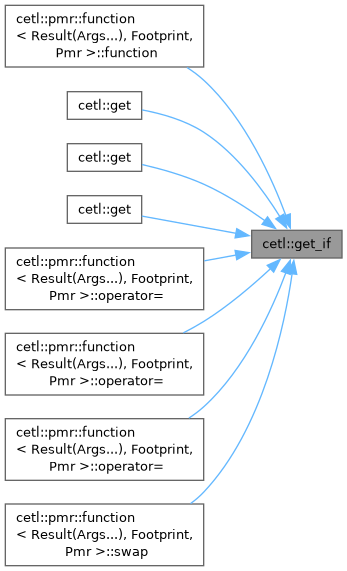
Referenced by cetl::pmr::function< Result(Args...), Footprint, Pmr >::function(), get(), get(), get(), cetl::pmr::function< Result(Args...), Footprint, Pmr >::operator=(), cetl::pmr::function< Result(Args...), Footprint, Pmr >::operator=(), cetl::pmr::function< Result(Args...), Footprint, Pmr >::operator=(), and cetl::pmr::function< Result(Args...), Footprint, Pmr >::swap().
|
noexcept |
Performs type-safe access to the contained object.
| ValueType | Type of the requested value; may not be a reference. |
| UbVar | Template type of the unbounded_variant object. |
| operand | Target unbounded_variant object. |
ValueType matches that of the contents of operand, a pointer to the value contained by operand, otherwise a null pointer. References CETL_NODISCARD.
|
constexprnoexcept |
Implementation of std::get_if(std::variant).
|
constexprnoexcept |
Implementation of std::holds_alternative.
|
noexcept |
Detects whether the given object of a type that has a type ID but does not implement cetl::rtti::_cast_ (such as a non-polymorphic or built-in type) is an instance of the type with the given type ID.
Such an object is an instance of its own static type only.
References CETL_NODISCARD, has_type_id, and type_id_value.
|
noexcept |
Detects whether the given object is an instance of the given type.
Q shall satisfy cetl::has_type_id. Refer to the non-template overloads for details.
References CETL_NODISCARD, has_type_id, is_instance_of(), and type_id_value.
|
noexcept |
Detects whether the given polymorphic object is an instance of the type with the given type ID.
For example, given a polymorphic type hierarchy A<-B<-C, is_instance_of(C{}, get_type_id<X>())==true for X in {A,B,C}; while is_instance_of(A{}, get_type_id<X>())==true only for X=A.
Note that the type of the object argument is not rtti& but the actual type of the object, because in the presence of multiple inheritance implicit conversion to the base class is ambiguous.
References CETL_NODISCARD.
Referenced by is_instance_of().

|
constexprnoexcept |
Returns a pointer to the object of type T that is located at the address p holds.
Since C++17 (P0137R1) a pointer obtained by casting the address of some storage does not point to an object that was later created in that storage with placement new; it has to be passed through std::launder first. This is std::launder where the standard library provides it. Before C++17 the cast pointer already points to the object, so this returns p unchanged.
| T | The type of the object. Must not be a function type or (cv-qualified) void. |
| p | The address of an object of type T that is within its lifetime. |
|
constexpr |
An implementation of C++17 std::make_optional.
|
constexpr |
Returns an instance of overloaded that can be used with visit.
The usage is as follows:
References std::forward().
| CETL_NODISCARD UnboundedVariant cetl::make_unbounded_variant | ( | Args &&... | args | ) |
Makes an unbounded_variant object with in place constructed value.
Size of the value must be less than or equal to Footprint. Any failure during the construction will result in the "valueless by exception" state.
| ValueType | Type of the value to be stored. Its size must be less than or equal to Footprint. |
| UnboundedVariant | Template type of the result unbounded variant. |
| Args | Types of arguments to be passed to the constructor of ValueType. |
| args | Arguments to be forwarded to the constructor of ValueType. |
References CETL_NODISCARD, and std::forward().
| CETL_NODISCARD UnboundedVariant cetl::make_unbounded_variant | ( | std::initializer_list< Up > | list, |
| Args &&... | args ) |
Makes an unbounded_variant object with in place constructed value and initializer list.
Size of the value must be less than or equal to Footprint. Any failure during the construction will result in the "valueless by exception" state.
| ValueType | Type of the value to be stored. Its size must be less than or equal to Footprint. |
| UnboundedVariant | Template type of the result unbounded variant. |
| Up | Type of the elements of the initializer list. |
| Args | Types of arguments to be passed to the constructor of ValueType. |
| mem_res | Pointer to a memory resource to be used by the variant. |
| list | Initializer list to be forwarded to the constructor of ValueType. |
| args | Arguments to be forwarded to the constructor of ValueType. |
References CETL_NODISCARD, and std::forward().
| CETL_NODISCARD UnboundedVariant cetl::make_unbounded_variant | ( | typename UnboundedVariant::pmr_type *const | mem_res, |
| Args &&... | args ) |
Makes a PMR-enabled unbounded_variant object with in place constructed value.
Size of the value must be less than or equal to Footprint to benefit small object optimization, otherwise the value will be stored into PMR allocated storage. Any failure during the construction will result in the "valueless by exception" state.
| ValueType | Type of the value to be stored. Its size must be less than or equal to Footprint. |
| UnboundedVariant | Template type of the result unbounded variant. |
| Args | Types of arguments to be passed to the constructor of ValueType. |
| mem_res | Pointer to a memory resource to be used by the variant. |
| list | Initializer list to be forwarded to the constructor of ValueType. |
| args | Arguments to be forwarded to the constructor of ValueType. |
References CETL_NODISCARD, and std::forward().
| CETL_NODISCARD UnboundedVariant cetl::make_unbounded_variant | ( | typename UnboundedVariant::pmr_type *const | mem_res, |
| std::initializer_list< Up > | list, | ||
| Args &&... | args ) |
Makes a PMR-enabled unbounded_variant object with in place constructed value and initializer list.
Size of the value must be less than or equal to Footprint to benefit small object optimization, otherwise the value will be stored into PMR allocated storage. Any failure during the construction will result in the "valueless by exception" state.
| ValueType | Type of the value to be stored. Its size must be less than or equal to Footprint. |
| UnboundedVariant | Template type of the result unbounded variant. |
| Up | Type of the elements of the initializer list. |
| Args | Types of arguments to be passed to the constructor of ValueType. |
| mem_res | Pointer to a memory resource to be used by the variant. |
| list | Initializer list to be forwarded to the constructor of ValueType. |
| args | Arguments to be forwarded to the constructor of ValueType. |
References CETL_NODISCARD, and std::forward().
|
noexcept |
Performs a safe dynamic type up-/down-conversion in constant time by invoking cetl::rtti::_cast_.
T shall be a pointer and std::remove_pointer_t<T> shall satisfy cetl::has_type_id. Returns nullptr if a safe dynamic type conversion to T is not possible.
References type_id_value.
|
noexcept |
Performs a safe type conversion for types that have a type ID but do not implement cetl::rtti::_cast_, such as non-polymorphic types and built-in types.
Such types carry no runtime type information beyond their static type, so the conversion succeeds iff std::remove_pointer_t<T> is the static type of the object, ignoring cv-qualifiers (which can be added but not removed). Matching type IDs are not sufficient because a derived type may inherit the _get_type_id_() of its base; conversion to a base class is not supported. Returns nullptr if the object pointer is null or the static types differ.
|
noexcept |
Performs a safe dynamic type up-/down-conversion in constant time by invoking cetl::rtti::_cast_.
T shall be a pointer and std::remove_pointer_t<T> shall satisfy cetl::has_type_id. Returns nullptr if a safe dynamic type conversion to T is not possible.
References type_id_value.
|
noexcept |
Performs a safe type conversion for types that have a type ID but do not implement cetl::rtti::_cast_, such as non-polymorphic types and built-in types.
Such types carry no runtime type information beyond their static type, so the conversion succeeds iff std::remove_pointer_t<T> is the static type of the object, ignoring cv-qualifiers (which can be added but not removed). Matching type IDs are not sufficient because a derived type may inherit the _get_type_id_() of its base; conversion to a base class is not supported. Returns nullptr if the object pointer is null or the static types differ.
The type ID getter for the given type.
This helper is provided for regularity; it returns the same value as T::_get_type_id_(). The type shall satisfy cetl::has_type_id. Specialize this getter to add RTTI support to types where it is not possible to define a static method (e.g., pointers, third-party classes, etc). The built-in types are already specialized by CETL below. Specialize it only for cv-unqualified non-reference types; cetl::type_id_value strips the qualifiers.
|
constexprnoexcept |
Type ID getter specializations for the built-in (fundamental) types, which cannot define _get_type_id_().
These make the built-in types usable with cetl::unbounded_variant and the RTTI helpers out of the box. The values are fixed UUIDs that are part of the CETL API; they will not change between releases.
|
constexprnoexcept |
The type ID getter specialization reserved for void type - returns all zeros.
|
constexprnoexcept |
Type ID getter specializations for the built-in (fundamental) types, which cannot define _get_type_id_().
These make the built-in types usable with cetl::unbounded_variant and the RTTI helpers out of the box. The values are fixed UUIDs that are part of the CETL API; they will not change between releases.
|
constexprnoexcept |
A helper that converts cetl::type_id_type to cetl::type_id.
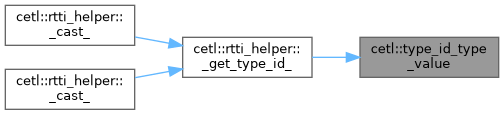
Referenced by cetl::rtti_helper< TypeIDType, Bases >::_get_type_id_().
| ForwardIt cetl::pf17::uninitialized_move | ( | InputIt | first, |
| InputIt | last, | ||
| ForwardIt | destination ) |
Polyfill for std::uninitialized_move.
Implements the sequential, three-argument overload. Constructs objects from [first, last) in uninitialized storage starting at destination. Execution-policy overloads and uninitialized_move_n are not provided.
Lvalue sources are moved from, even when copying could avoid a throwing move constructor. Other source expressions retain their value category, as specified by LWG 3918. The destination value type must be constructible from std::move(*first) for lvalue source expressions, or from *first otherwise, under the active C++ language version's initialization rules.
The source range must be valid and must not overlap the destination range. The destination must provide sufficient, suitably aligned uninitialized storage for every source element. Destruction of destination objects must not throw. The caller owns the destination storage; this function neither allocates nor deallocates it. On success, all constructed objects remain alive and the caller is responsible for destroying them.
When dereferencing the source produces a prvalue of the destination type, C++17 and newer require no copy/move constructor for destination construction. In C++14, the selected copy/move constructor must be accessible and not deleted, and callers must not assume that its invocation will be elided.
Source elements may already have been moved from when an exception occurs; their original values are not restored. When compiled with exceptions disabled, no exception rollback is provided.
Complexity is linear in the number of source elements, with one destination construction per element on success.
| InputIt | Source iterator type meeting the input iterator requirements. |
| ForwardIt | Destination iterator type meeting the forward iterator requirements. Assignment, comparison, increment, and indirection through valid iterators must not throw, and indirection must yield a reference to the iterator's value_type. |
| first | Beginning of the source range. |
| last | End of the source range. |
| destination | Beginning of the destination storage. |
destination if the source range is empty. | ... | With exceptions enabled, propagates any exception from construction or a source iterator operation. Every destination object successfully constructed by this call is destroyed exactly once before propagation, in an unspecified order. The object whose constructor failed is not destroyed. |
|
constexpr |
Implementation of std::visit.
|
constexpr |
Implementation of std::conjunction_v.
|
constexpr |
Implementation of std::disjunction_v.
|
constexpr |
True iff T has a public static method _get_type_id_() or is a built-in type for which CETL provides a cetl::type_id_getter specialization.
CV-qualifiers and references are ignored. User-provided cetl::type_id_getter specializations are not detected.
Referenced by is_instance_of(), and is_instance_of().
|
constexpr |
Polyfill for std::in_place.
|
constexpr |
Implementation of std::in_place_index.
|
constexpr |
Implementation of std::in_place_type.
|
constexpr |
Implementation of std::is_nothrow_swappable_v.
|
constexpr |
True iff T has a public method _cast_().
|
constexpr |
Implementation of std::is_swappable_v.
|
constexpr |
Implementation of std::negation_v.
|
constexpr |
An implementation of C++17 std::nullopt.
|
constexpr |
This many bytes are used to represent a type ID. This is enough to hold a standard UUID (GUID).
|
constexpr |
The type ID value of the given type.
This helper is provided for regularity; it has the same value as T::_get_type_id_(). The type shall satisfy cetl::has_type_id or have a cetl::type_id_getter specialization. CV-qualifiers and references are ignored, so type_id_value<const int&> equals type_id_value<int>.
Referenced by is_instance_of(), is_instance_of(), rtti_cast(), and rtti_cast().
|
constexpr |
Implementation of std::variant_npos.
|
constexpr |
Implementation of std::variant_size_v.
This implementation also accepts other typelist-parameterized classes, such as std::variant.